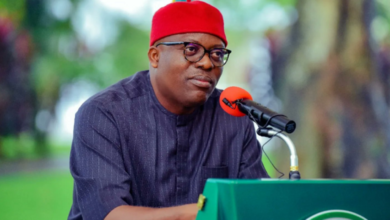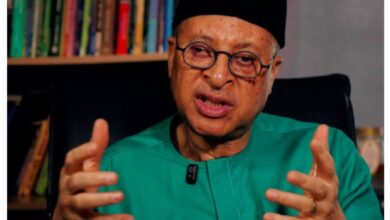

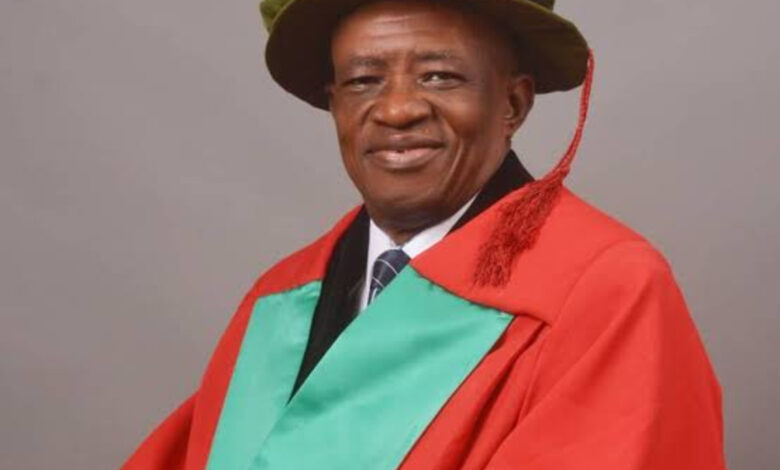
Agbedo stated this while delivering the university’s 255th inaugural lecture, titled “WordMatters: Sociolinguistic Calculus as Praxis for Interrogating Linguistic Banditry and Banditisation of Nigeria,” at the Princess Alexandra Auditorium and Theatre, UNN.
The occasion attracted a large gathering of dignitaries, including members of the university management, academic and non-teaching staff, students, government functionaries, traditional rulers and other prominent personalities.
Agbedo introduced what he called Sociolinguistic Calculus (SLC), an analytical framework for examining how meanings change across contexts, how language serves particular interests and how repeated patterns of linguistic manipulation become normalised in society.
He distinguished between linguistic banditry, which he described as “the deliberate distortion or appropriation of meaning to mislead and advance certain interests,” and banditisation, which refers to the process through which such practices become widespread, normalised and institutionalised.
Using examples from political and governance discourse, the lecturer explained how public officials and other influential actors could deploy language to shift responsibility, disguise failures and legitimise questionable actions.
He also presented the Sociolinguistic Liberation Thesis, Universal Appropriation Grammar (UAG) and Governance Optimality Theory (GOT) as additional frameworks for examining the relationship between language, power, institutional choices and accountability.
According to him, governance outcomes could remain defective when competing interests and institutional constraints were managed in ways that prioritised narrow political interests over the common good.
Moving from diagnosis to possible solutions, Agbedo proposed Remedial Sociolinguistic Calculus (RSLC) as a framework for restoring clarity of meaning, reclaiming linguistic agency and challenging the manipulation of public discourse.
He also disclosed that the Krisagbedo Linguistic Engine (KLiEN), a multilingual, artificial intelligence-enabled platform, was designed to identify, analyse and clarify linguistic manipulation.
He explained that the platform would help citizens interrogate public claims and understand the use of language without imposing censorship or replacing individual judgment.
The professor further introduced Visual Pragmatics as an emerging area for examining how images, cartoons, memes and other visual materials communicate meaning, ideology and power.
He maintained that the corruption of meaning could precede and facilitate the corruption of institutions, noting that constitutions could exist without constitutionalism, elections without democracy, and courts without justice when the language and purposes of such institutions were distorted.
Earlier, the UNN Vice-Chancellor, Prof. Simon Ortuanya, represented by the Deputy Vice-Chancellor (Academic), Prof. Kamoru Usman, said the university’s inaugural lecture was a significant academic tradition that provided a platform for scholars to showcase their research contributions, share knowledge and advance intellectual discourse on issues of societal importance.