
Aletheia University Gets Full Licence, Expands Programmes to 34 — VC
Temidayo Israel
Aletheia University, Ago-Iwoye, Ogun State, has secured a full licence from the National Universities Commission (NUC) following an assessment of its operations, marking a major milestone in the institution’s development since its establishment in 2023.
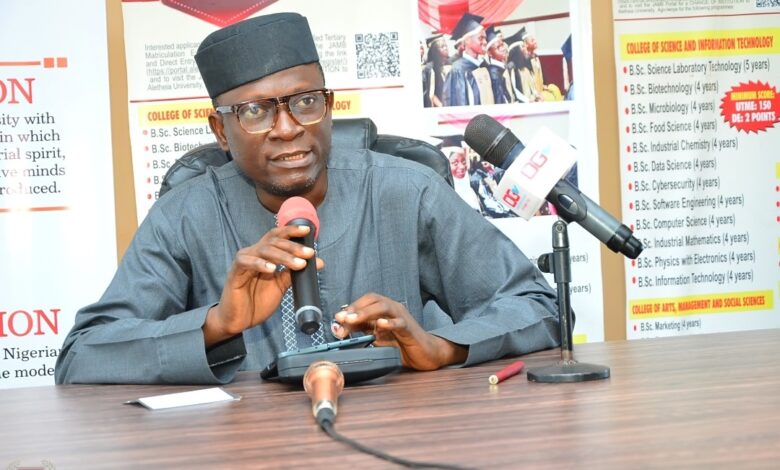
The Vice-Chancellor, Professor Olukayode D. Akinyemi, disclosed this at a press conference, where he reviewed the university’s achievements, ongoing projects and future plans. He said the development reflected the institution’s commitment to academic excellence, sound administration and compliance with regulatory standards.
Akinyemi explained that the university, licensed on June 5, 2023, commenced academic activities in the 2023/2024 session with 33 students and 17 approved degree programmes. According to him, enrolment rose to 208 in the 2024/2025 session and 276 in 2025/2026, while the current student population has exceeded 500.
He added that the institution had expanded its approved academic programmes from 17 to 34, with expectations of admitting close to 500 new students in the next academic session, scheduled to commence towards the end of October 2026, subject to the admissions process.
The vice-chancellor said the NUC conducted an assessment visit to the university from March 15 to 18, 2026, to review its provisional licence, examining teaching and learning, research, financial management, governance, administration and institutional management. He described the outcome, communicated in October, as an important step in consolidating the university’s position within Nigeria’s higher education system.
On academic development, Akinyemi said the university was adopting a Four Certifications Model designed to equip students with academic knowledge, professional competence, information and communication technology skills, and entrepreneurship capabilities. He explained that the approach was intended to prepare graduates not only for paid employment but also for innovation, enterprise development and self-reliance.
He further disclosed that the university’s Law programme had received approval from the Council of Legal Education, while 13 other programmes were being prepared for accreditation. The institution, he said, had also commenced Joint Universities Preliminary Examinations Board (JUPEB) and pre-degree programmes in the 2025/2026 academic session to provide additional pathways to university admission.
Akinyemi added that the university had introduced tuition rebates for eligible students studying Agriculture, subject to applicable conditions, as part of efforts to encourage agricultural education and contribute to food security. He said its operational Centre for Entrepreneurship was also helping to promote business skills, creativity and the practical application of academic knowledge.
On infrastructure, the vice-chancellor said the university had completed its library and cafeteria, while its existing student hostel had a capacity of 1,000. He disclosed that additional hostel facilities were under development and staff quarters were nearing completion to support the institution’s expanding operations.
He also said the university was undertaking a comprehensive revamp of its laboratories to improve practical teaching, experimentation and research in science, engineering and other disciplines. Improvements to its Mass Communication studios and English Language laboratory were equally underway to strengthen students’ professional and practical competencies.
The vice-chancellor identified international collaboration as another priority, listing partnerships with the International Cultural Communication Center, Malaysia; Shenzhou University, China; NED University of Engineering and Technology, Pakistan; and I Believe Global, United States. Within Nigeria, he said, the university maintained relationships with the International Institute of Tropical Agriculture (IITA), the Nigerian Institution of Electrical and Electronic Engineers, New Horizons ICT Resource Centre and Jobberman Nigeria.
According to him, the partnerships were intended to promote knowledge exchange, research collaboration, technological development, agricultural advancement and students’ readiness for the workplace. He cited training facilitated through Jobberman Nigeria as an example of initiatives designed to improve students’ career prospects, while the relationship with IITA supported the university’s interest in agricultural development and food security.
On community engagement, Akinyemi said the university was committed to strengthening its relationship with its host community through practical interventions and mutually beneficial initiatives. He listed the training and empowerment of poultry farmers, the provision of fresh meat and fish at subsidised rates, inter-school debates, gender sensitisation programmes and mentoring activities among its community-focused engagements.
He also highlighted the importance of staff development, research and effective governance, noting that the university conducted leadership training twice a year to improve management capacity. He said its governance structure, comprising the Board of Trustees, Governing Council and Senate, provided strategic direction, administrative oversight and academic supervision. He acknowledged the roles of the Founder and Chancellor, Major General (Dr.) Sansadeen Adebanjo Awosanya (Rtd.), and the Governing Council chaired by Chief (Mrs.) Onikepo Akande.
Looking ahead, Akinyemi said the university would continue to strengthen its academic standards, improve infrastructure, deepen research and innovation, and pursue partnerships that would create meaningful opportunities for students and staff. He stressed that the transition to a full licence should not be regarded as a reason for complacency but as a call for greater accountability and sustained performance.
He maintained that the institution’s ambition was to build a university that combined academic excellence with character development, employability, entrepreneurship and service to society. He said the university would continue to align its growth with quality assurance, responsible management and the changing needs of the country, while ensuring that its expansion translated into tangible benefits for students, staff and the wider community.